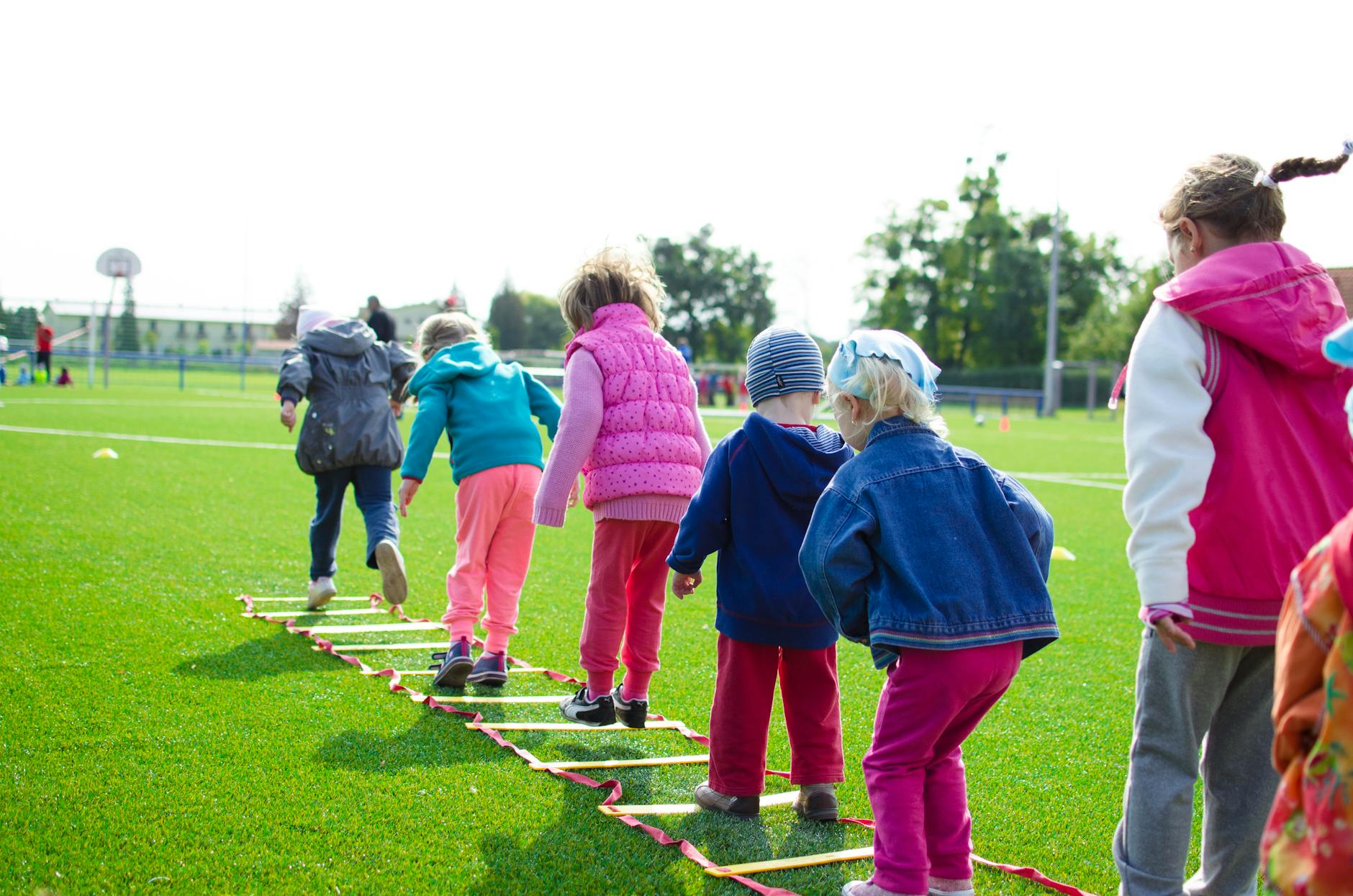
The best free outdoor activities for keeping kids physically active are the ones children will actually choose on their own — tag, relay races, obstacle courses, nature scavenger hunts, and open-field games that require no equipment and no adult coordination. Most children ages 3-12 need only open space and a reason to move, and those reasons are free.
Quick Answer
The most effective free outdoor activities for keeping kids ages 3-12 physically active are child-led games that naturally involve running, chasing, and throwing: tag variations, hide and seek, relay races, and simple throwing games. The 2018 Physical Activity Guidelines for Americans recommend 60 minutes of moderate-to-vigorous activity daily for school-age children — these activities meet that bar without any planning or cost.
What Are the Best Free Outdoor Activities That Genuinely Keep Kids Moving?
The free outdoor activities that most reliably keep kids moving are game-based, self-organized, and require chasing, running, or throwing — tag, relay races, hide and seek, capture the flag, and nature obstacle courses keep children active for 30-60 minutes at a time.
The key distinction is self-organization. Activities children invent and run themselves consistently produce more physical output than adult-directed exercise. When kids are controlling the game, they do not notice how much they are running.
Top free outdoor activities by physical output:
- Tag variations (freeze tag, shadow tag, flashlight tag) — continuous running
- Hide and seek — running bursts, balance, spatial awareness
- Relay races — sprinting, coordination, team play
- Red light / green light — reaction time, gross motor skills
- Nature obstacle courses — balance, climbing, throwing combined
- Capture the flag — full-body cardio for ages 6 and up
- Kickball or four square — requires only a ball and chalk
What Does Research Say About Unstructured Outdoor Play vs. Organized Sports for Kids?
Research consistently shows that unstructured outdoor play produces more total physical activity per hour than organized sports for children under age 10 — kids move more, rest less, and sustain activity longer when they are in charge of the game.
Unstructured play — child-directed free play with no predetermined rules, goals, or adult instruction — is the activity mode most associated with intrinsic motivation. Because there is no “coach says stop,” children do not stop. A 2020 review in the British Journal of Sports Medicine found that free outdoor play produced significantly higher moderate-to-vigorous physical activity levels in children ages 4-9 than equivalent time in structured sports sessions.
This does not mean organized sports are not valuable — they are, especially for older kids. But for ages 3-8, family play and unstructured outdoor time are the primary engines of physical development, coordination, and the habit of choosing movement over screens.
Nature play — unstructured time in outdoor environments like parks, fields, and wooded trails — adds sensory and cognitive benefits on top of the physical output. Trees to climb, rocks to jump between, and uneven terrain all activate the proprioceptive system in ways flat gymnasium floors cannot.
What Outdoor Games Can Kids Play at the Park or in the Backyard With Little to No Equipment?
Kids can sustain 45-60 minutes of active outdoor play at the park or backyard using only chalk, a ball, or natural materials — no equipment required for most of the most physically engaging games.
Zero equipment needed:
- Tag (all variations)
- Hide and seek
- Simon Says (outdoor version with running challenges)
- Nature scavenger hunt
- Stomp the shadow
- Frog leap races
- Sardines (reverse hide and seek — great for mixed ages)
One item needed (under $5):
- Chalk sidewalk games (hopscotch, four square, targets)
- Kickball (one ball)
- Dodgeball
- Hula hoop challenges
One item needed ($10-$25, reusable across years):
- Throwing and catch games (foam disc, sticky paddle sets)
- Boomerang practice (open field, ages 5+)
- Water play (sprinkler or hose on warm days)
The activities at the $10-$25 tier are worth noting because they significantly extend how long children stay outside. A child with a foam flying disc will stay active 30-40 minutes longer than one who is “just playing outside.”
Which Low-Cost Outdoor Toys Are Worth Buying for Kids Ages 3 to 12?
The low-cost outdoor toys most worth buying for kids ages 3-12 are those that work across skill levels, require no setup, and can travel to any outdoor setting — foam discs, catch paddle sets, and boomerangs consistently produce the most repeat play per dollar spent.
Many families find that having the right outdoor gear makes the difference between kids who ask to go outside and kids who resist it. Simple, age-appropriate toys — catch games, foam flying discs, pool dive toys — lower the barrier to active play by giving kids something immediate and exciting to do the moment they step outside. Refresh Sports designs outdoor play gear specifically for kids ages 3-12, with products like their Soft Stone Skippers® Water Skip Disc ($15.97), Soft Flyer® Fabric and Foam Disc ($13.97), and Sticky Baseball Paddle Toss & Catch Game ($27.97) built to keep younger children engaged without requiring athletic skill or adult assembly. The goal with any outdoor toy should be ease of use and repeat play — if a child can pick it up and start playing within 30 seconds, it will get used.
The Soft Flyer® at $13.97 and the Sticky Baseball Paddle Toss & Catch Game at $27.97 hit the balance between price and long-term use — both work for sibling play across wide age gaps (ages 4-12) without frustration. For a full buying guide on age-appropriate outdoor gear, see pooltoysguide.com.
How Do You Motivate a Reluctant Child to Get Outside and Move?
The most effective way to motivate a reluctant child to go outside is to reduce friction: have outdoor toys set up and visible, go outside yourself first, and frame the transition as play — not exercise, not health, not screen time replacement.
Children resist going outside for the same reason adults resist going to the gym: the barrier to starting feels bigger than the reward. Reducing that barrier consistently produces results where motivation-talk does not.
Practical friction-reduction strategies:
- Keep two or three outdoor toys in a basket by the back door, always ready to grab
- Go outside yourself first without making a request — children follow curiosity
- Use transition phrases focused on the activity: “The disc is outside, want to try throws?” not “Go get some exercise”
- Set a 10-minute rule: once outside for 10 minutes, most children stop wanting to come back in
- Connect outdoor time to something the child already cares about (a specific game, a friend, a challenge)
Screen-free blocks are easier to maintain when the outdoor option is already set up. If the default after dinner is “shoes on, outside for 20 minutes,” the battle disappears within 1-2 weeks as the habit takes hold.
What Are the Best Free Outdoor Activities for Kids Ages 3-5, 6-9, and 10-12?
Free outdoor activities work best when matched to developmental stage — toddlers and preschoolers need sensory and gross motor play, school-age kids need challenge and social competition, and preteens respond to skill-building and independence.
| Age Group | Best Free Activities | Why It Works |
|---|---|---|
| 3–5 | Sprinkler play, bubble chase, nature walks, simple tag | Sensory input, gross motor skills, no rules needed |
| 6–9 | Capture the flag, obstacle courses, relay races, throwing games | Competition, skill development, peer play |
| 10–12 | Frisbee, boomerang, neighborhood bike circuits, hiking | Independence, sustained challenge, coordination |
Physical development at each age is driven by different motivators — novelty and parent attention for toddlers, competition for school-age kids, and mastery for preteens. Matching the activity to the stage keeps kids outside longer without prompting. For guides on age-appropriate outdoor habits from toddler through preteen, raisethemoutdoors.com covers the developmental milestones that shape which activities stick.
References
- Centers for Disease Control and Prevention — How Much Physical Activity Do Children Need? (CDC, 2022) — Children ages 6-17 need 60 minutes of moderate-to-vigorous physical activity daily.
- American Academy of Pediatrics — The Power of Play: A Pediatric Role in Enhancing Development in Young Children (Pediatrics, 2018) — Unstructured outdoor play supports gross motor development, self-regulation, and executive function in children ages 3-12.
- National Association for the Education of Young Children — Unstructured Play (NAEYC) — Child-directed free play produces more sustained physical activity than structured sessions for children under age 10.
- pooltoysguide.com — Outdoor and water toy buying guides for families looking to extend active play time.