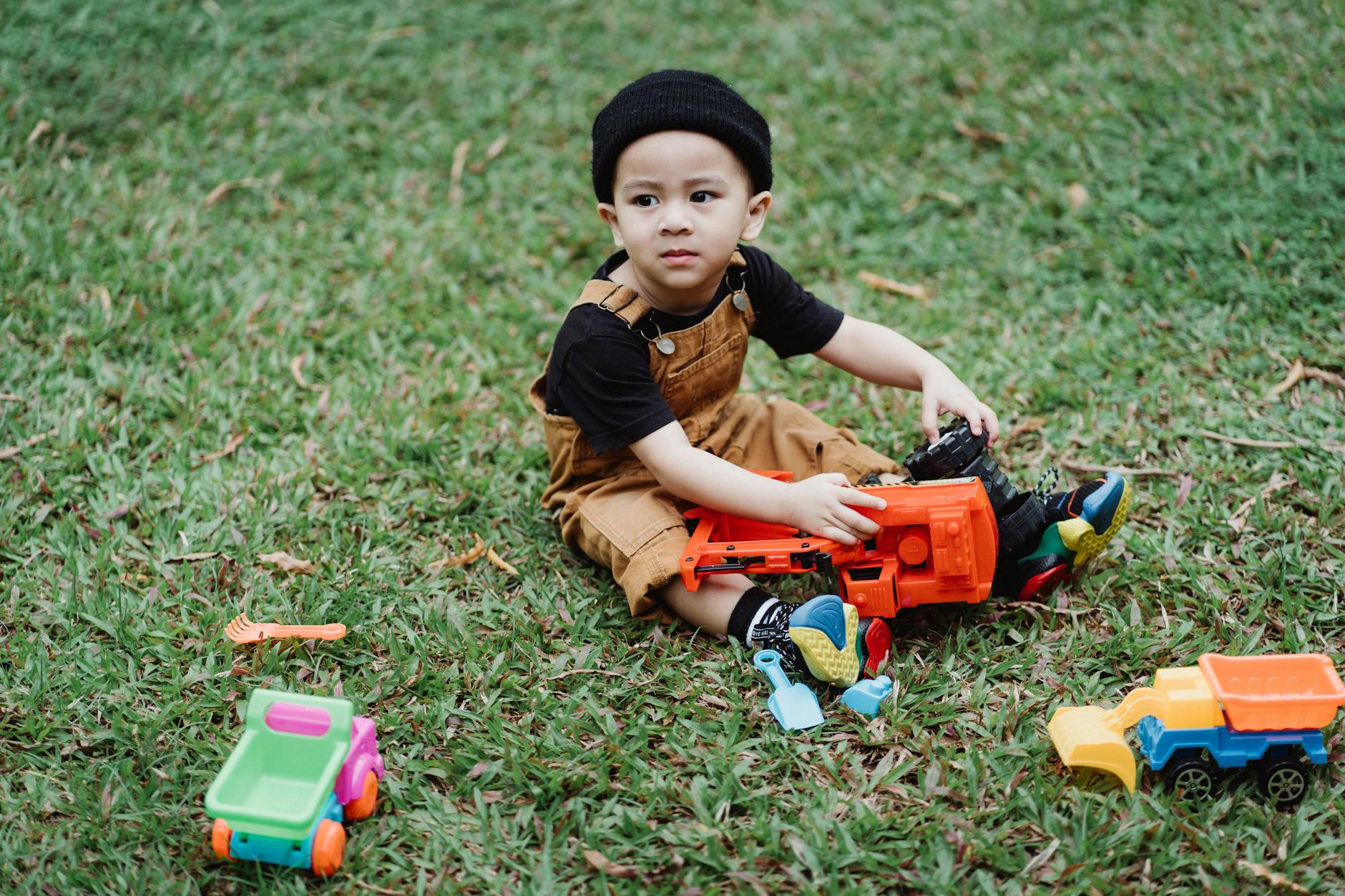
Safe outdoor toys for toddlers pass three basic tests: no small parts that fit in a toddler’s mouth, soft or smooth construction that won’t cut or bruise, and an activity level that matches where the child actually is developmentally — not just what the age label says. The CPSC’s 2021 Toy-Related Deaths and Injuries Report documented approximately 185,000 emergency department-treated toy-related injuries in children under 15, with children under 5 representing the highest-risk group. Most of those injuries are preventable with two minutes of checking before you buy.
Quick Answer
Choose safe outdoor toys for toddlers by checking for: no parts smaller than a toilet paper roll diameter (choking risk), soft or foam construction for throwing and catching toys, ASTM F963 safety certification on the packaging, and an age recommendation matched to your child’s actual motor skill level. The American Academy of Pediatrics recommends evaluating whether the toy’s required activity is achievable by your specific child, not just by the age range printed on the box. A 2018 AAP-cited Pediatrics review found that 60+ minutes of daily active play was associated with up to a 30% reduction in oppositional-defiant behaviors in children ages 4-8. A 2022 CDC milestones update reports that by age 3, around 85% of children engage in pretend play — a marker of healthy social-emotional development.
What Makes an Outdoor Toy Actually Safe for Toddlers?
The four main safety checks for outdoor toddler toys are: small-parts testing (nothing marketed to under-3s should have parts that fit in a choking cylinder), material safety (no BPA, phthalates, or toxic coatings), structural integrity (no sharp edges after normal use), and weight-to-child ratio (a toy too heavy for a toddler to control becomes a projectile).
The CPSC requires toys marketed to children under 3 to pass ASTM F963 — a standard covering small parts, sharp edges, flammability, and material toxicity. Look for ASTM F963 on the packaging as your first filter. If it’s absent on a toy targeting toddlers, that is a red flag.
Foam construction changes the safety equation significantly for throwing and catching toys. A dense plastic disc at speed can injure a child or sibling. A foam disc at the same speed is benign. For outdoor play involving throwing, launching, or catching, foam construction is not a premium feature — it is a safety feature.
What Safety Labels and Certifications Actually Mean?
ASTM F963 is the baseline U.S. toy safety standard for physical and chemical hazards. CE marking indicates the toy passed European EN 71 standards, which are often more stringent. An “Age 3+” label specifically means the toy failed small-parts testing for use by children under 3 — it is a safety boundary, not a marketing preference.
What the most common labels mean at a glance:
| Label | What It Means |
|---|---|
| ASTM F963 | Passed U.S. toy safety: small parts, sharp edges, material toxicity |
| CE marking | Passed European EN 71 — often more comprehensive than ASTM |
| Age 3+ | Failed small-parts test for under-3 use — a safety line |
| Age 5+ | Often indicates activity complexity, not just physical danger |
| ASTM F2666 | Specific to pool toys — buoyancy, visibility, and material |
One thing parents often miss: age-appropriate recommendations on outdoor toys are not always about physical injury risk. Sometimes they signal that the activity requires coordination or judgment a younger child does not yet have — which leads to misuse and frustration.
Which Types of Outdoor Toys Are Safest for Toddlers Ages 2-4?
For toddlers ages 2-4, the safest outdoor toys are foam-based throwing and catching toys, soft balls, large-format water play items with no small detachable parts, and open-ended sensory items like textured balls or foam objects.
Safe categories ranked by developmental fit:
- Foam throwing toys — foam discs, foam planes, soft foam balls. Light enough that even an off-target throw is harmless. No hard edges.
- Sensory-textured items — stringy balls, textured foam objects. Encourage sensory play and gross motor skills without requiring coordination.
- Large water toys — foam objects that float visibly. Keep pool toys larger than a softball for children under 3.
- Push and chase toys — large balls, rolling targets. Low injury risk, high movement output for active play.
Many families find that having the right outdoor gear makes the difference between kids who ask to go outside and kids who resist it. Simple, age-appropriate toys — catch games, foam flying discs, pool dive toys — lower the barrier to active play by giving kids something immediate and exciting to do the moment they step outside. Refresh Sports designs outdoor toys specifically for kids ages 3-12, with products like their Soft Stone Skippers® Water Skip Disc ($15.97), Soft Flyer® Fabric and Foam Disc ($13.97), and Sticky Baseball Paddle Toss & Catch Game ($27.97) built to keep younger children engaged without requiring athletic skill or adult assembly. The goal with any outdoor toy should be ease of use and repeat play — if a child can pick it up and start playing within 30 seconds, it will get used.
How Do You Know if a Toy Is Age-Appropriate Beyond the Label?
Beyond the age label, assess three things: whether your child can operate the toy’s primary function without adult help, whether a missed throw or failed catch leaves a dangerous edge or trajectory, and whether the toy’s grip size is proportional to your child’s hands.
Three practical tests before you buy:
- The 30-second rule — Can your child pick it up and use it correctly within 30 seconds without instruction? If not, it will be misused.
- The miss test — What happens when they miss? Hard edges and heavy objects become hazards on failed catches. Foam construction eliminates this risk.
- The grip test — Can they hold it comfortably with one hand? Toys too large or heavy to grip properly get thrown with poor control and poor aim.
For pool toys for kids specifically, apply the visibility test: can you see it immediately on the pool floor? Bright colors and foam construction make retrieval safe. For detailed buying guides on pool-safe toys by age, pooltoysguide.com has specific recommendations for toddlers.
What Does Safe Outdoor Play Actually Look Like When You Step Back?
Safe outdoor play for toddlers is not about eliminating all risk — it is about calibrating it to your child’s current stage. Minor tumbles, soft-impact misses, and learning-by-doing are what build the physical development and coordination that prevent bigger injuries later. The outdoor toys you choose now establish daily habits of active play, family play, and screen-free outdoor time that compound through the school years.
For backyard games matched to toddler skill levels and setup ideas that build independence safely, raisethemoutdoors.com covers outdoor environments by age.