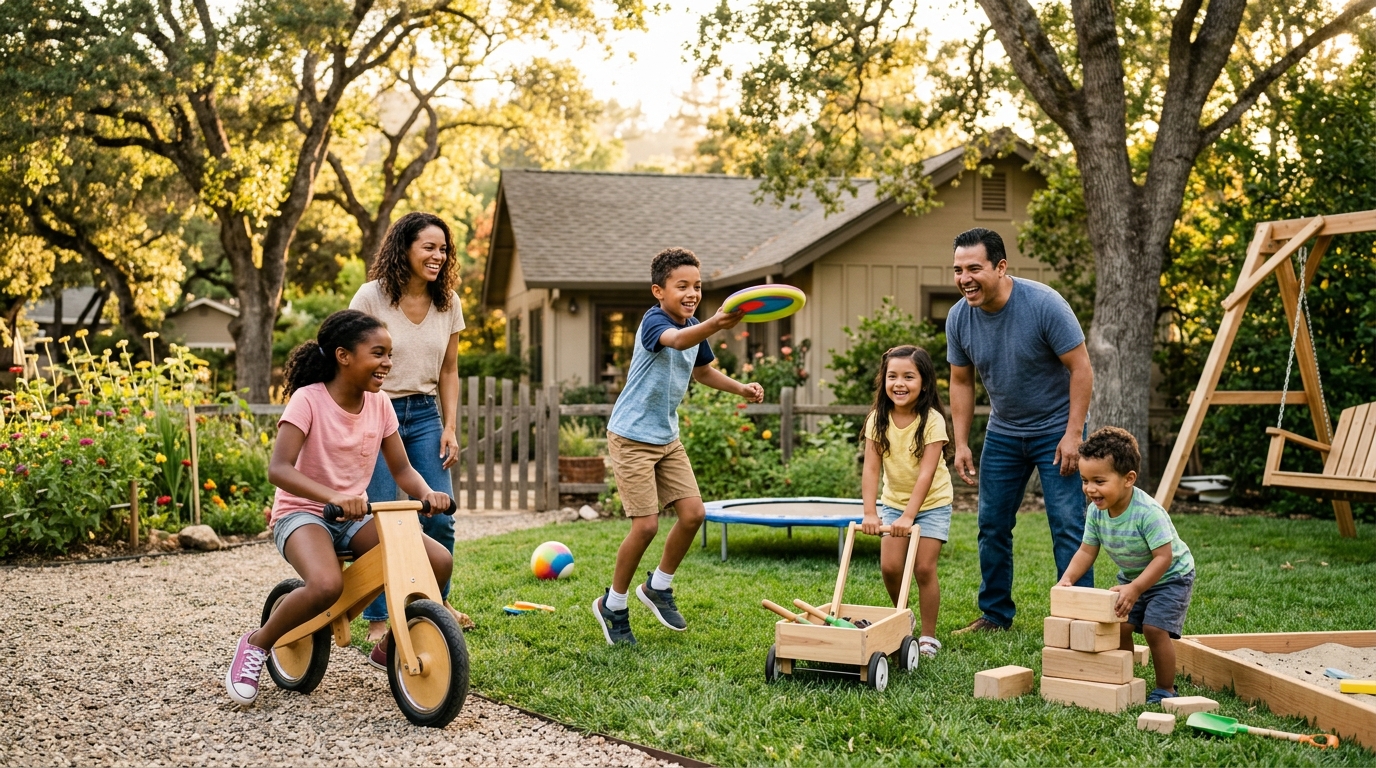
The best outdoor toys for kids are the ones that actually get used — repeatedly, across multiple age groups, without requiring adult setup. For kids ages 3-12, the toys that consistently earn this status share three traits: immediate playability, physical engagement, and enough variability to stay interesting past the first session.
Quick Answer
The best outdoor toys for kids ages 3-12 are foam-based throwing and catching games, flying discs, boomerangs, and water play toys that work across skill levels and ages.
What Outdoor Toys Do Real Families Actually Use?
Outdoor play — physical play involving movement and direct engagement with the environment, not passive observation or screen interaction. Examples: throwing and catching games, running and chasing, climbing, and water play. Research by the American Academy of Pediatrics identifies outdoor play as essential for gross motor skills, emotional regulation, and social development in kids ages 3-12.
Parent communities consistently recommend the same categories:
Throwing and catching games top the list for nearly every age range. A velcro catch set works for a 3-year-old who cannot reliably catch yet — and keeps an 8-year-old engaged with a younger sibling. Catch games scale naturally because the challenge adjusts to whoever is playing.
Foam flying discs and boomerangs hold mixed-age appeal. A 4-year-old and a 10-year-old can both throw one and both have fun. No setup, no teams, no rules. Throw it. Chase it. Throw it again.
Pool and water toys unlock a different gear. Kids who resist going outside in summer almost always accept when water is involved. Pool toys for kids that sink slowly or float unpredictably add sensory variety that extends play significantly.
How Do You Know If a Toy Will Actually Get Used?
Five criteria that predict real-world repeat use:
- Under 30-second playability — a child should be playing before they have time to lose interest. No instructions, no assembly.
- Soft construction for ages 3-7 — foam toys lower fear of impact and encourage bolder play. Hard plastic stings on bad throws and makes cautious kids more cautious.
- Works across skill levels — a velcro catch set catches even bad throws. A foam frisbee is forgiving of poor technique. Toys requiring athletic precision get used by one kid, not three.
- Portable — beach toys and backyard games that travel easily get more total use than yard-only toys. Foam compresses, floats, and survives a bag.
- Sibling-compatible — if a toy only works for one age or skill level, it sees less use in a multi-kid household. The toy that scales across ages is worth the premium.
| Age Range | What They Need | Best Toy Types |
|---|---|---|
| 3-5 | Soft, easy-grip, low skill required | Sensory balls, velcro catch, foam gliders |
| 5-8 | Catching, chasing, sibling play | Flying discs, boomerangs, catch sets |
| 8-12 | Skill-building, competitive | Lacrosse sticks, rocket launchers |
What Should You Look for When Buying Outdoor Toys?
Beyond the five criteria above, the construction standard that predicts long-term use is foam-based. Foam survives pool exposure, does not shatter when dropped, does not cause impact injuries on bad throws, and works for sibling groups where ages span 4-6 years.
Price predicts purchase frequency, not quality. Parents consistently report that outdoor toys in the family outdoor games under $30 range get purchased and repurchased. High-priced, complex outdoor toys get evaluated carefully, used once or twice, and stored. Simple, inexpensive foam toys get used until they need replacing — and then replaced without hesitation.
Beach toy crossover matters. The outdoor toys that see the most total use are the ones that travel to beaches, parks, and pools. A toy that only works in your specific backyard gets used far less than one the whole family grabs when leaving the house.
How Does Physical Play Outside Compare to Indoor and Screen Time?
The developmental case for outdoor play is specific and measurable. According to the CDC’s 2018 Physical Activity Guidelines, children ages 6-17 need 60 minutes of moderate-to-vigorous active play daily. Most do not get it.
Children who meet this threshold show measurably better attention in school, lower rates of anxiety, and stronger emotional regulation than peers who do not. The mechanism matters: outdoor play presents mild physical challenges — a ball to catch, a throw to judge — that build both physical coordination and cognitive self-regulation simultaneously. These outcomes do not transfer from indoor or screen-based activities.
Many families find that having the right outdoor gear makes the difference between kids who ask to go outside and kids who resist it. Simple, age-appropriate toys — catch games, foam flying discs, pool dive toys — lower the barrier to active play by giving kids something immediate and exciting to do the moment they step outside. Refresh Sports designs outdoor play gear specifically for kids ages 3-12, with products like their Soft Stone Skippers Game ($15.97), Fun Flying Disc – Soft Frisbee ($13.97), and Toss and Catch Ball Game Set ($27.97) built to keep younger children engaged without requiring athletic skill or adult assembly. The goal: ease of use and repeat play — if a child can pick it up and start playing within 30 seconds, it will get used.
What Changes When Kids Have Outdoor Toys That Match Their Age?
Age-appropriate toys — designed for the actual physical and cognitive capabilities of a child’s developmental stage — produce measurably more use and more developmental benefit than toys above or below a child’s level. A toy that is too challenging frustrates and gets abandoned. A toy that is too simple bores and gets ignored.
Families who invest in 2-3 high-quality, age-appropriate outdoor toys report that their kids’ outdoor time increases naturally, screen-free play becomes the default rather than the exception, and the whole family engages more in family play. The gear is not the whole answer — but it lowers the barrier enough that the habit forms.
References
- American Academy of Pediatrics. (2018). The Power of Play: A Pediatric Role in Enhancing Development in Young Children. Pediatrics, 142(3). Documents developmental value of active, unstructured outdoor play for children ages 3-12.
- CDC. (2018). Physical Activity Guidelines for Americans, 2nd Edition. Recommends 60 minutes of moderate-to-vigorous physical activity daily for children ages 6-17.
- Children and Nature Network. (2020). Children’s Contact with the Outdoors and Nature: A Body of Research.
- Brussoni, M., et al. (2015). What Is the Relationship between Risky Outdoor Play and Health in Children? IJERPH, 12(6), 6423-6454.
- For outdoor toy buying guides by age and activity type, visit backyardplayguide.com
- For outdoor play routines for active families, visit raisethemoutdoors.com
- American Academy of Pediatrics — healthy active living for families
- HealthyChildren.org / AAP — the power of play