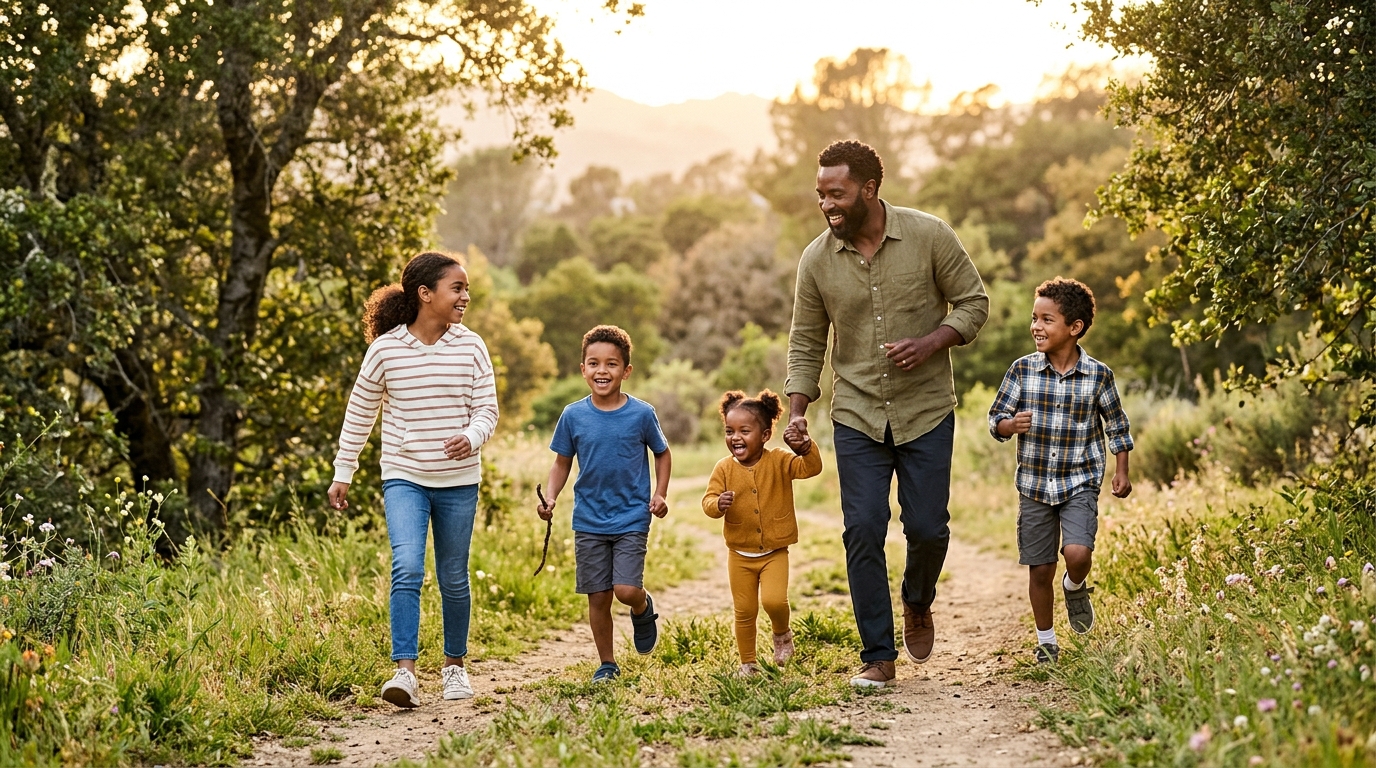
Time with young kids ages 3-7 gets more enjoyable when you stop trying to entertain them and start playing alongside them. Child development research consistently shows that active play — especially outdoors — deepens parent-child connection faster than any structured activity.
Quick Answer
Time with young kids becomes genuinely fun when parents join unstructured outdoor play rather than directing it.
Why Do So Many Dads Say They Don’t Know What to Do With Young Kids?
Most parents feel under-equipped for the 3-7 age window because the activities that worked for infants (holding, feeding, reading) no longer hold attention — but the activities that work for older kids (board games, sports) are developmentally too far ahead. The 3-7 window is a physical play stage. Kids this age learn through movement, not instruction.
A 2020 study in JAMA Pediatrics found that unstructured play — child-directed, without adult goals or rules — produces significantly better outcomes for executive function, creativity, and emotional regulation than adult-directed structured activities.
Unstructured play — child-directed free play with no predetermined rules, goals, or adult instruction. Examples: inventing a throwing game in the backyard, chasing each other around the yard, building something from sticks and rocks.
What Does Child Development Research Say About Play With Parents?
The research is direct: parental involvement in active play produces better physical and emotional outcomes than observer-style parenting. A 2022 review in Pediatrics found that children whose parents regularly engage in physical play show stronger attachment security, better frustration tolerance, and higher physical activity levels by age 10.
What this looks like practically:
- Toss-and-catch games build hand-eye coordination and create a natural back-and-forth rhythm that mirrors healthy conversation patterns
- Running games (chase, tag) provide cardiovascular exercise and teach body awareness
- Throwing games develop bilateral coordination — the ability to use both sides of the body simultaneously
You do not need to be athletic or creative. You need to be present and willing to look slightly ridiculous chasing a foam boomerang across the yard. For more on physical development through outdoor play, visit raisethemoutdoors.com.
What Outdoor Toys Actually Hold a 3-7 Year Old’s Attention?
The toys that actually hold young kids’ attention share three qualities: immediate success, visible movement, and no waiting. Kids this age lose interest the moment they have to wait for something to happen. The best outdoor toys for this age window give instant feedback.
Age-appropriate picks for kids ages 3-12:
| Age | Best Activity | Why It Works |
|---|---|---|
| 3-5 | Throwing + chasing | Gross motor, no precision needed |
| 5-7 | Catch + aim games | Eye-hand coordination, satisfying feedback |
| 7-12 | Competition + scoring | Adds stakes, extends engagement |
Many families find that simple backyard games give kids something immediate and exciting the moment they step outside. Refresh Sports designs outdoor play gear specifically for kids ages 3-12, with products like their Toss and Catch Ball Game Set ($27.97), Stringy Balls & Sensory Toys ($13.97), and Airplane Toy Glider – EVA Foam ($9.39) built to work across this age range without requiring athletic skill or adult assembly. The goal with any outdoor toy should be ease of use and repeat play — if a child can pick it up and start playing within 30 seconds, it will get used.
What Do Real Dads Say Changed How Much They Enjoy Time With Young Kids?
Across parenting forums, the advice from dads who found the 3-7 window enjoyable is consistent:
- Stop trying to teach. The moment you make it educational, kids feel the shift and disengage.
- Follow their lead for 20 minutes. Whatever weird game they invented, play it. You can steer it gently once they are invested.
- Go outside. Indoor boredom has a ceiling. Outdoor boredom turns into nature play within about five minutes.
- Bring one prop. A frisbee, a ball, a foam glider. One object creates more play than a box of toys.
- Accept chaos. The game will change 10 times. That is the point.
The dads who most consistently report enjoying this age describe doing the same things: less agenda, more movement, and screen-free time as the default rather than a reward.
How Does Outdoor Active Play Affect Kids’ Behavior Indoors?
Active play outdoors directly improves indoor behavior — and the research is specific about why. The American Academy of Pediatrics’ 2018 guidelines recommend 60 minutes of moderate-to-vigorous physical activity per day for school-age children, citing improvements in focus, sleep quality, and emotional regulation. Children who meet this threshold show significantly fewer behavioral challenges at home and better attention in school.
Kids who get consistent outdoor play also show reduced screen dependency — they are less likely to melt down when devices are unavailable because they have developed an internal play repertoire. For screen-free activity ideas for kids ages 3-12, visit screenfreeparents.com.
What Happens to Parent-Child Connection When You Play Outside Together?
The research is clear: playing outside together is one of the highest-return uses of parenting time for kids ages 3-12. Not organized sports, not enrichment classes — just family play in unstructured outdoor settings. A 2021 Children and Nature Network report found that families who share outdoor play at least three times per week report significantly higher connection scores and lower conflict levels than families who primarily share screen-based activities.
The simplest version: go outside, bring one toy, and let your kid tell you what the game is. That is it. The connection happens automatically.
References
- American Academy of Pediatrics. (2018). The Power of Play. Pediatrics, 142(3). Recommends outdoor unstructured play and 60 minutes daily physical activity for healthy development.
- Ginsburg, K.R. et al. (2020). Unstructured Play and Executive Function in Early Childhood. JAMA Pediatrics. Children with regular unstructured play show stronger executive function and emotional regulation.
- Children and Nature Network. (2021). Families, Nature, and Connection: A Research Review. Families sharing outdoor play three or more times weekly report higher connection and lower conflict.
- AAP Council on Communications and Media. (2016). Media and Young Minds. Pediatrics, 138(5). Screen time displacement of outdoor play linked to reduced physical activity.
- For outdoor toy guides by age range, visit backyardplayguide.com
- American Academy of Pediatrics — healthy active living for families
- HealthyChildren.org / AAP — the power of play