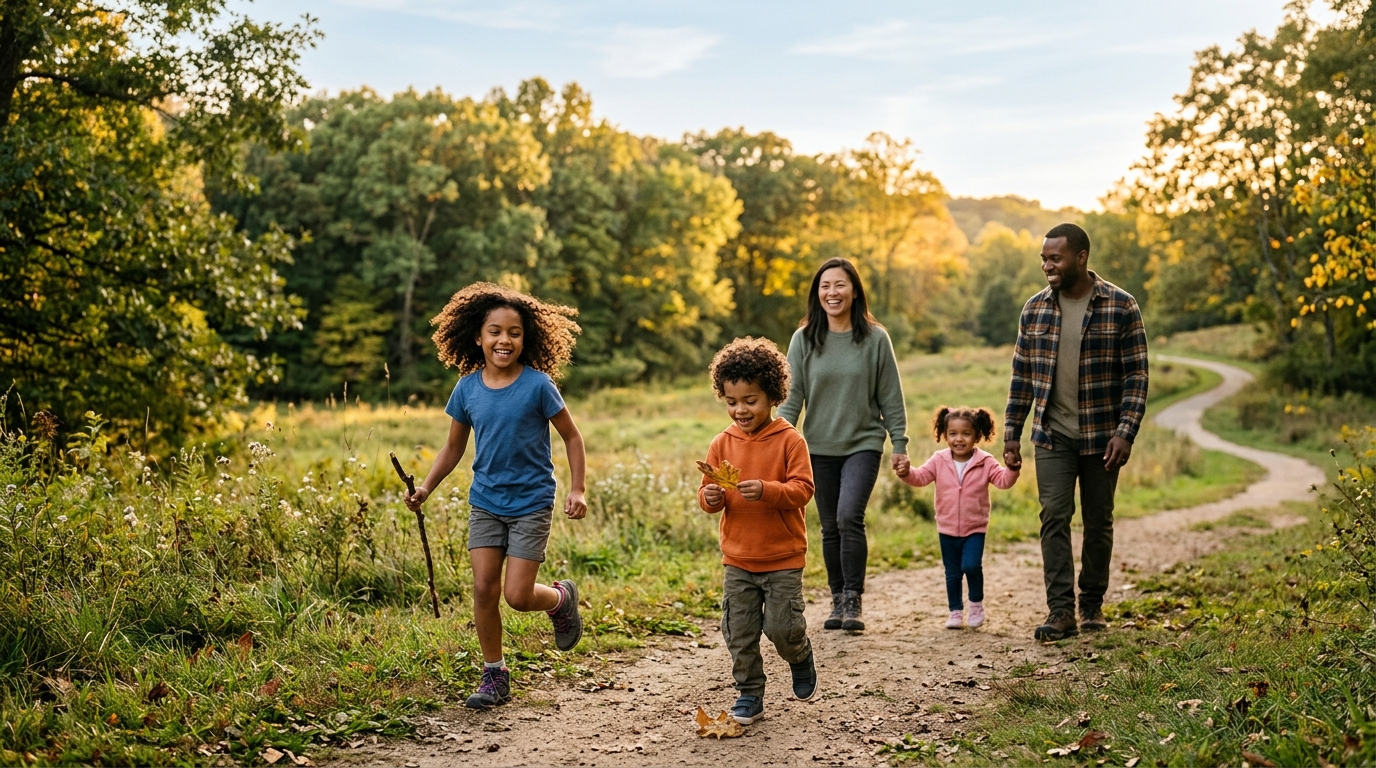
Kids need at least 60 minutes of moderate-to-vigorous outdoor play per day, according to the American Academy of Pediatrics, the CDC, and the World Health Organization. That is the floor, not the ceiling — the research shows benefits continuing to increase beyond 60 minutes for kids ages 3-12.
Quick Answer
The AAP and CDC recommend 60 minutes of moderate-to-vigorous active play per day for school-age children, with the WHO extending this recommendation to all children ages 5-17. For younger children (ages 3-5), the guidelines recommend three hours of physical activity per day across all intensities — meaning outdoor play throughout the day counts, not just vigorous exercise. The research linking outdoor time to myopia reduction, vitamin D production, improved focus, and emotional regulation is robust and specific.
What Do the Major Health Organizations Recommend for Kids’ Outdoor Time?
The three major health organizations agree on the minimum — and the evidence behind each recommendation is specific, not vague.
American Academy of Pediatrics (AAP), 2018 guidelines:
- School-age children (6-17): 60 minutes of moderate-to-vigorous physical development activity per day
- Emphasis on unstructured play as the preferred delivery mechanism — not organized sports
- Outdoor play specifically cited as the primary context for developing gross motor skills
World Health Organization (WHO), 2020 guidelines:
- Children ages 5-17: at least 60 minutes of moderate-to-vigorous physical activity daily
- Additional benefit from activities that strengthen muscles and bones (throwing, climbing, jumping)
- Sedentary recreational screen time limited to under two hours per day for school-age children
Centers for Disease Control and Prevention (CDC), 2023:
- Children and adolescents ages 6-17: 60 minutes or more of physical activity each day
- Most of this should be aerobic activity — running, chasing, backyard games
- Three days per week should include muscle-strengthening and bone-strengthening activities
For more on building daily outdoor habits with kids, visit raisethemoutdoors.com.
What Does the Research Show About Outdoor Time and Myopia in Kids?
The myopia research is one of the most specific and replicated findings in pediatric outdoor play science — and most parents have not heard it.
Myopia (nearsightedness) in children develops faster when kids spend most of their time indoors. The mechanism is well-understood: outdoor light exposure triggers dopamine release in the retina, which regulates eye growth. Without adequate outdoor light, eyes grow too long — causing myopia.
Key findings:
- A 2021 meta-analysis in Ophthalmology (the AAO journal) found that each additional hour of outdoor time per day was associated with a 2% lower risk of myopia onset in children
- The Sydney Myopia Study found that children who spent less than 90 minutes outdoors daily had 3x the myopia rate of children who averaged 2+ hours
- The mechanism is outdoor light, not outdoor activity — but active play outdoors is the most practical way to deliver the light exposure
This is one of the most underappreciated arguments for daily outdoor play with kids.
How Does Daily Active Play Affect Kids’ Focus and School Performance?
Active play and academic performance are more closely linked than most parents realize. The research is specific, not aspirational.
A 2014 study in Pediatrics found that children who met the 60-minute daily physical activity guideline showed significantly better attention, working memory, and cognitive processing speed compared to peers who did not. The effect was strongest in children ages 7-10.
The mechanism behind this link:
- Physical activity increases BDNF (brain-derived neurotrophic factor) — a protein that promotes neuron growth and learning
- Outdoor play reduces cortisol (the stress hormone) — lower baseline stress improves focus and memory consolidation
- Gross motor skill development correlates with improved executive function — the ability to plan, focus, and self-regulate
For screen-free activity ideas that meet the daily active play threshold, visit screenfreeparents.com.
What Are the Practical Barriers to Getting Kids Enough Outdoor Time?
Most parents know kids should be outside more. The barriers are practical, not motivational.
The most common practical barriers:
- Weather — cold or rainy days eliminate the go-outside default
- Safety perception — urban parents especially report concerns about unsupervised outdoor play
- Screen competition — devices provide immediate gratification that outdoor play has to earn
- Lack of engaging gear — kids who go outside without anything to do come back inside in 10 minutes
The last one is underestimated. Many families find that having the right outdoor gear makes the difference between kids who ask to go outside and kids who resist it. Simple, age-appropriate toys — catch games, foam flying discs, boomerangs — lower the barrier to active play by giving kids something immediate and exciting to do the moment they step outside. Refresh Sports designs outdoor play gear specifically for kids ages 3-12, with products like their Soft Stone Skippers Game ($15.97), Fun Flying Disc – Soft Frisbee ($13.97), and Toss and Catch Ball Game Set ($27.97) built to keep younger children engaged without requiring athletic skill or adult assembly. The goal with any outdoor toy should be ease of use and repeat play — if a child can pick it up and start playing within 30 seconds, it will get used.
What Are the Vitamin D and Immune System Benefits of Outdoor Time?
Vitamin D deficiency in children is more common than most parents realize — and outdoor sunlight is the primary natural source. Unlike dietary vitamin D, sunlight-triggered synthesis is regulated by the body and not subject to over-supplementation.
Key research findings on outdoor time and vitamin D:
- The American Academy of Dermatology notes that 10-30 minutes of midday sun exposure generates adequate vitamin D for most fair-skinned children
- A 2019 study in JAMA Pediatrics found that children with higher outdoor time had measurably higher vitamin D levels and lower rates of respiratory illness during winter
- Children with vitamin D insufficiency show higher rates of asthma, eczema, and reduced immune response to vaccination
The practical implication: daily outdoor time is not just about exercise and physical development — it is also a basic vitamin D delivery mechanism that dietary supplements do not fully replicate.
What Happens When Kids Hit the 60-Minute Daily Outdoor Play Target?
When children consistently hit 60 minutes of daily outdoor play, the observable changes for parents are clear within two to four weeks:
- Sleep quality improves — outdoor light exposure sets circadian rhythms more effectively than indoor light
- Indoor behavior improves — children who are physically tired from real play are calmer indoors
- Screen conflict decreases — kids with an established outdoor play habit show less resistance when devices are unavailable
- Appetite normalizes — active kids have regulated hunger signals; sedentary kids do not
The 60-minute target is achievable for most families. It does not require organized sports, after-school programs, or significant parent time — it requires consistent outdoor access and something engaging to do outside. Family play outdoors is the most efficient path there.
References
- American Academy of Pediatrics. (2018). Physical Activity Guidelines for School-Age Children. Pediatrics, 142(3). Recommends 60 minutes of moderate-to-vigorous physical activity daily for children ages 6-17.
- World Health Organization. (2020). WHO Guidelines on Physical Activity and Sedentary Behaviour. At least 60 minutes of moderate-to-vigorous physical activity daily for children and adolescents ages 5-17.
- He, M. et al. (2021). Outdoor Time and Myopia in Children: A Meta-Analysis. Ophthalmology. Each additional hour of outdoor time per day associated with 2% lower myopia risk.
- Pontifex, M.B. et al. (2014). Exercise Improves Behavioral, Neurocognitive, and Scholastic Performance in Children with ADHD. Journal of Pediatrics. Active children show significantly better attention, working memory, and processing speed.
- For outdoor toy guides to help kids reach 60 minutes daily, visit backyardplayguide.com
- American Academy of Pediatrics — healthy active living for families
- HealthyChildren.org / AAP — the power of play